Use case credit
Jay Levy @ZelkovaVC
Jay Levy (@ZelkovaVC) shared a Claude skill that merges a property manager's owner statements with a bookkeeper's financials, in a thread on X on Oct 7, 2026.
The Owner Statement Problem: Two Sets of Numbers That Never Met
Jay Levy is an early-stage VC who also owns rental properties. The thread starts with the problem: "Every month I got two sets of numbers that never met: my bookkeeper's financials and my property manager's statements. So I built a Claude skill that merges them into one owner report."
Levy shared an anonymized example report in the post, but not the skill file or the scripts, so we describe only what the thread says it does.
How the Claude Skill Turns an Owner Statement Into One Owner Report
Owner Statement Inputs: The Files You Already Have
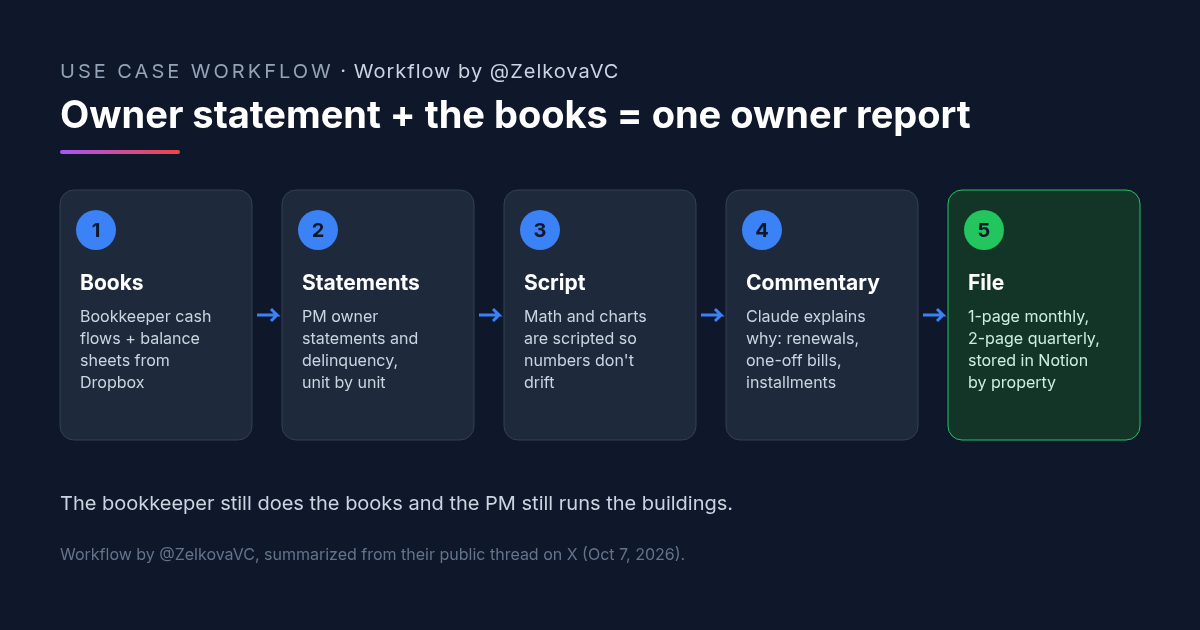
"It works with the files I already have. It pulls the bookkeeper's cash flows and balance sheets from Dropbox and reads the PM's owner statements and delinquency reports unit by unit."
Owner Statement Math in a Script, Judgment From Claude
"Every month: a one-page PDF (operating statement, rent roll, lease calendar, outstanding rent, cap rate, open actions) plus a 2-page quarterly. Math and charts are scripted so numbers don't drift; Claude handles the judgment calls."
Owner Statement Commentary: Why the Numbers Moved
"It also writes the commentary. Not just 'NOI up 24%' but why: which units renewed, which bills were one-offs, who's paying in installments, what's next."
When Levy adds a property, the skill does a one-time review, and "it flagged an upcoming loan rate reset."
Owner Statement History in Notion
"Everything is stored in Notion: Real Estate → each entity → each property, with monthly and quarterly report databases holding the PDFs, headline numbers and a detailed page. Every property's history is in one searchable place."
In a reply, Levy adds that the goal was a place for both the PDFs and more of the raw data, and that "my Claude project knows to check notion when i have a question on the real estate."
Why Scripted Math Matters in an Owner Statement Report
- Numbers don't drift. A script gives the same totals from the same files every month. A language model asked to add up a statement can give a slightly different answer each time.
- Claude does the part scripts can't. Explaining that NOI rose because certain units renewed, or that a bill was a one-off, takes reading the statements, not arithmetic.
- A skill repeats the same steps. The thread's closing line: "Skills are made for this kind of recurring work." The same inputs, rules and layout run every month.
- Nobody's job changes. "The bookkeeper still does the books and the PM still runs the buildings. I just see the whole picture before our monthly call."
How to Try It: An Owner Statement Report Prompt
Levy didn't publish their skill. The prompt below is ours, built from the inputs and outputs in their thread. Use it in a Claude project first; once the output is right for two or three months, save it as a skill. Have a script, or at least a spreadsheet, produce the totals, and give Claude those numbers along with the source files.
[CRE AI Studio prompt, written for this article]
You prepare my monthly owner report for [PROPERTY], owned by [ENTITY].
Inputs attached:
- The property manager's owner statement and delinquency report for [MONTH].
- My bookkeeper's cash flow statement and balance sheet for [MONTH].
- A table of this month's totals calculated by my script. Use these numbers as given. Do not recalculate or change them.
Produce a one-page report with these sections: operating statement, rent roll, lease calendar, outstanding rent, cap rate, open actions.
Then write short commentary on why the numbers moved versus last month: which units renewed or turned over, which bills were one-offs, which tenants are paying in installments, and what's coming up next.
Rules:
- Where the owner statement and the bookkeeper's figures disagree, list each difference with both numbers and the source file. Don't pick one.
- Cite the file for every figure in the commentary.
- If something isn't in the files, say so. Don't guess.
- End with open questions for my call with the property manager.What to Check in an AI Owner Statement Report
- Totals tie out. Each month, check that the report's income and expense totals match the owner statement and the bookkeeper's cash flow.
- Differences are listed. Timing differences between the PM's statement and the books are normal. They should show up as a list, not be smoothed over.
- Commentary has a source. Every "why" in the commentary should point to a line in a statement or report.
- Flags get followed up. Items like the loan rate reset their skill caught are only useful if someone acts on them.
- File access. Give the skill read access to the folders it needs and nothing more.
FAQ: Owner Statement to Owner Report With Claude
What is an owner statement in property management?
Can Claude combine an owner statement with bookkeeper financials?
What goes in the owner report built from the owner statement?
Does a Claude owner statement skill replace the bookkeeper or property manager?
More AI use cases
All use cases →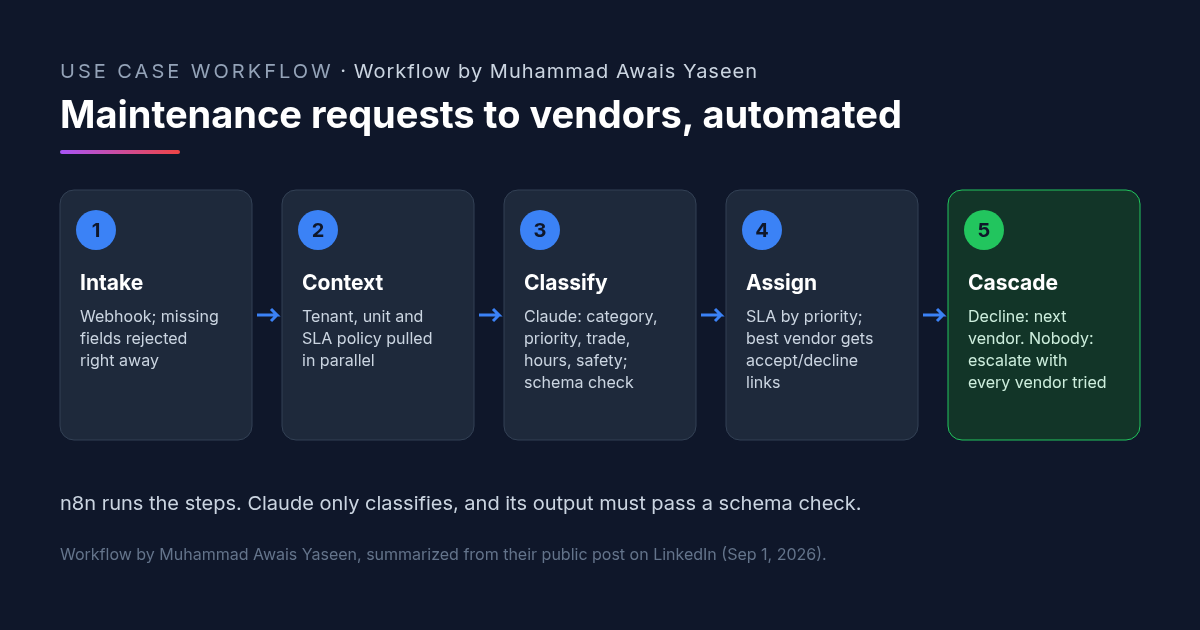
Property Management Automation: n8n and Claude Route Maintenance Requests to Vendors
Property management automation for maintenance: n8n validates the request, Claude classifies it, the best vendor gets accept/decline links, declines cascade.
Credit: in/awais-yaseen-automation · Oct 23, 2026 · 6 min read
Property Management Reporting: 23 Emailed PMS Reports Into a Dashboard the Owner Can Change
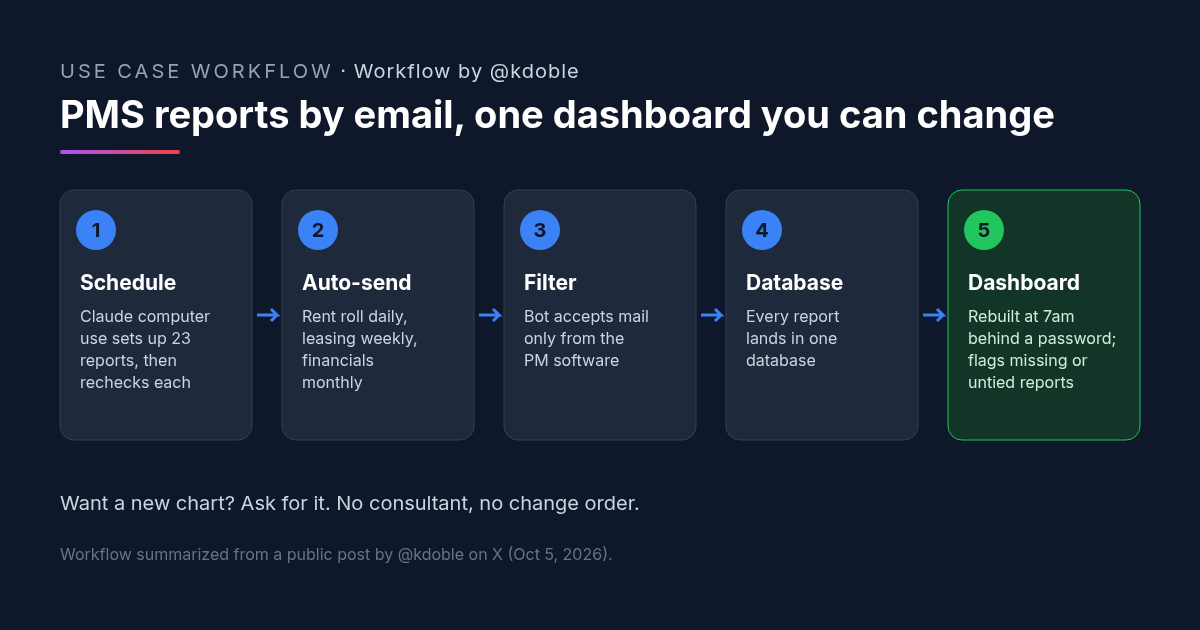
Property management reporting without a data feed: 23 PMS reports auto-email a bot that rebuilds an owner dashboard daily, set up by Claude computer use.
Credit: @kdoble · Oct 23, 2026 · 5 min read
Late Rent Notice Prompt: One AI Template So Every Manager Sends the Same Notice
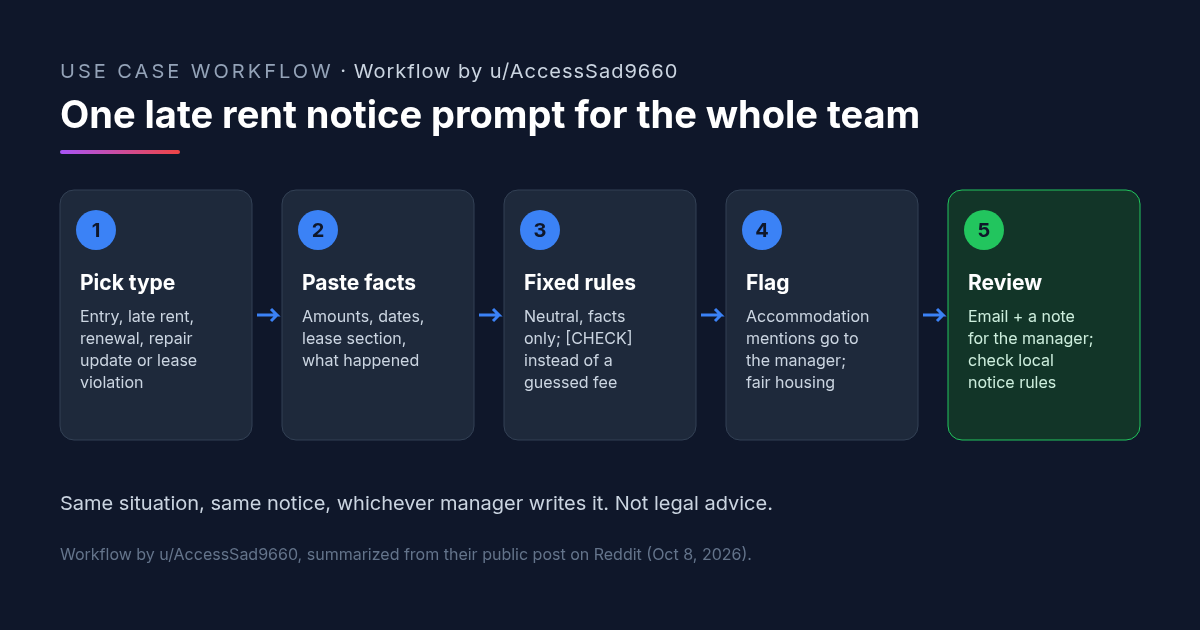
A late rent notice AI prompt for property teams: pick the notice type, paste the facts, and the same neutral rules apply. [CHECK] replaces guessed fees.
Credit: u/AccessSad9660 · Oct 23, 2026 · 6 min read