Use case credit
Brandon Turner @BeardyBrandon
Brandon Turner (@BeardyBrandon) published this Grok Bot guide as an article on X on Nov 13, 2026. He also promotes his own AI group and consulting in the article.
What Turner Built: AI for Real Estate Investors Organized Like a Company
Brandon Turner says he has been a real estate investor for 20 years and is putting AI into every part of a portfolio of more than 13,000 units. His Nov 13 article on X is a long guide to how he uses Grok Bot. Most of it is about structure, not prompts.
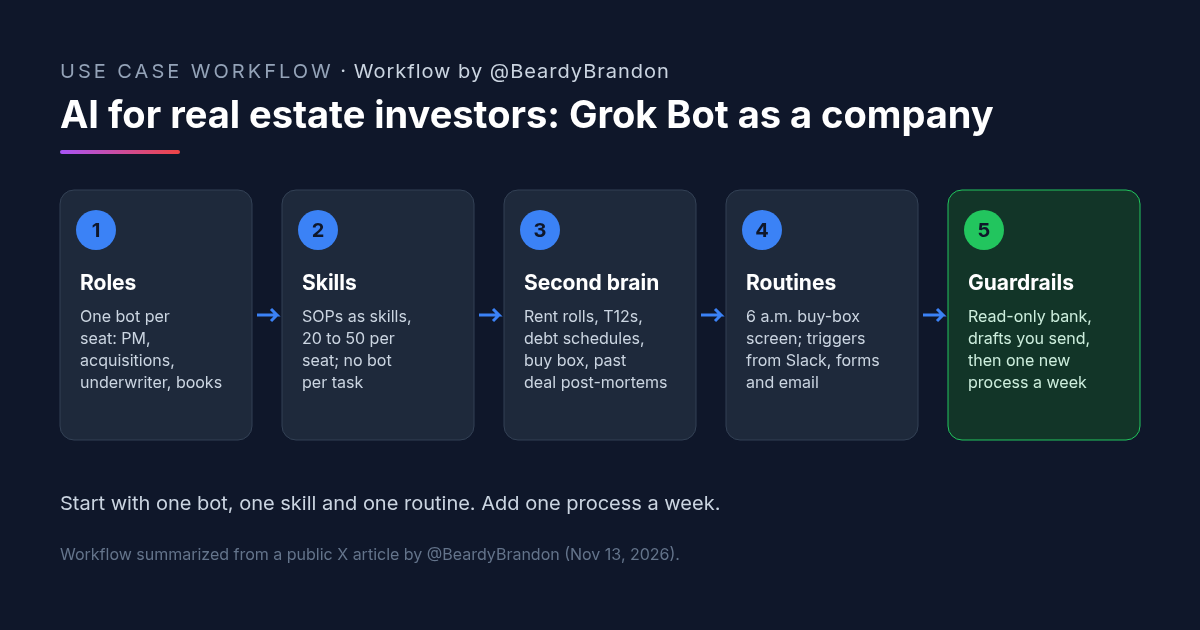
His model is the org chart. A real estate business has roles, such as acquisitions, finance and property management. People in those roles are trained, and they run processes: "This, then this, then this." Processes get handed from one team to the next. In his setup, each bot is a role and each process is a skill:
- Bots are seats. He names them by role: Polly the property manager, Art for acquisitions, Uma the underwriter, Bob the bookkeeper.
- Skills are SOPs. "A skill is just a document that lays out the SOP." A seat "might hold 20 to 50 of them." Polly might hold maintenance triage, lease renewals, move-in checklists and late rent follow-ups.
- Don't build a bot per task. "Please don't build 50 tiny bots for 50 tasks." Split a seat only when the business outgrows it, for example spinning leasing out of property management at 500 units.
- One bot you talk to. A primary bot acts as chief of staff and routes work to the others. Bots hand work to each other: "Art finds the deal, Uma runs the numbers, and Art drafts the email to the broker for you to approve."
His example of a process is a tenant maintenance call: record the call, get the details, send emergencies to 911, rate the issue from Level 1 to Level 5, log it in the tenant's file, and open a repair ticket for maintenance. That's the level of detail a skill needs.
The Second Brain Behind AI for Real Estate Investors
Turner's strongest point applies to any AI tool. "Real estate investors MUST build a Second-Brain system for their business." He describes it as "just a folder structure on your computer" holding the details of the business. His list includes:
- Property addresses, tenants' names and mortgage due dates
- Monthly T12s and budget-vs-actuals for every property
- Current rent rolls, concessions, delinquencies and market rents
- Your exact buy box and instant deal-breakers
- Debt schedules for every loan: rates, IO expiration dates, DSCR rules and rate caps
- Entity org charts and LLC operating agreements
- KPI scorecards, property management meeting notes, capex budgets and unit-turn trackers
- Property tax protest deadlines and insurance renewal dates
- Investor updates, broker lists, rent comps by submarket, and past deal post-mortems with your "never again" rules
Because it's plain files, "you're never locked into one AI company." His suggestion: keep it on your own computer and have it copied daily to Grok Bot's cloud computer and to Google Drive, so every bot works from the same context.
AI for Real Estate Investors on a Schedule: Routines, Triggers and a Bot Inbox
Turner separates work that runs on a clock from work that should start the moment something happens.
- Scheduled routines. His example: "Every morning at 6 a.m., pull the new listings in my buy box, run the numbers, and rank them by cash flow."
- Triggers. A bot can wake when someone posts in a Slack or Teams channel or when he adds a specific emoji reaction, so an eyes reaction on a shared broker listing sends Uma to underwrite it in the thread. A webhook can wake a bot from a website seller form or property management software, so a late-night form fill gets researched and a follow-up drafted right away.
- A bot inbox. Instead of giving a bot his whole inbox, he sets a Gmail or Outlook rule that forwards only broker OMs, lender term sheets, tax bills or contractor invoices to the bot's own address, with +tags such as +deals or +invoices to start different routines.
His rule of thumb: "use a schedule for batch jobs" and "a trigger when speed matters."
Guardrails Turner Uses With AI for Real Estate Investors
The parts of his setup that touch money and outside contacts have limits:
- Read-only banking. Bank accounts, cards and loans connect read-only, so a bookkeeping bot can flag a duplicate landscaper charge or a water bill that doubled but "still can't move a single dollar."
- You hit send. Emails and messages show up as drafts, and nothing goes out until he sends it.
- Approval for risky actions. Submitting forms, deleting files, changing settings or spending money pauses for approval. As a bot earns trust, he adds plain-English allow rules, the way you'd give a new hire more room after six months.
- Logins stay locked up. Site logins live in a vault or 1Password, not in a chat.
His one measured result: when he first connected an AI CFO to read-only bank feeds in one of his companies, "it spotted over $1,000 a month in spending I didn't even know about in the first 30 minutes," and it helped cut that company's weekly bookkeeping "from about 40 hours down to about 5."
How to Try AI for Real Estate Investors: One Bot, One Skill, One Routine
Turner warns against building "45 bots this weekend." His starting sequence: build one bot with a name and a role, train it on who it is, what it's responsible for and what good looks like, give it one skill you do over and over, and put that skill on a routine. Then add one more process the next week. He calls this the Leverage Loop: one human process becomes one AI process every week.
Turner didn't publish a prompt in the article. The setup below is CRE AI Studio's, built on his underwriter example and his 6 a.m. routine.
[CRE AI Studio prompt, written for this article from Brandon Turner's setup]
You are Uma, the underwriter for [company]. You screen new listings against our buy box. Read our buy box and deal-breakers in [second brain folder/buy-box file] before every run.
Skill: Morning buy-box screen
1. Every morning at 6 a.m., pull the new listings in my buy box from [source].
2. For each listing, run the numbers using our assumptions in [assumptions file]: price, rent, expenses, debt terms and cash flow. Mark any number you estimated instead of read from the listing.
3. Drop anything that hits a deal-breaker and say which one.
4. Rank the rest by cash flow and send me the top [5] with a one-line reason each and the listing link.
Limits: don't contact brokers or sellers. Draft any outreach for my approval. If a source or file is missing, tell me instead of guessing.What to Check Before You Rely on AI for Real Estate Investors
- Residential vs. commercial fit. Turner's examples lean residential (a BRRRR calculator, a "we buy nasty houses" seller form, tenant maintenance calls) with some apartment properties. The structure carries over to commercial work; the specific routines need your own data sources and underwriting rules.
- Second brain accuracy. A bot's answer is only as good as the files. He says it himself: "if your data is right," you get an accurate answer. Assign someone to keep rent rolls, debt schedules and T12s current.
- Estimated numbers. In a buy-box screen, separate figures read from the listing from figures the bot assumed.
- Money stays read-only. Keep bank, card and loan connections read-only and keep payments a human action.
- Outbound messages. Keep broker, tenant and seller messages as drafts you approve until a bot has a track record.
- Promotional context. The article promotes Turner's AI group and consulting. The setup steps above are the ones he shares publicly.
FAQ: AI for Real Estate Investors With Grok Bot
How should AI for real estate investors be set up?
What is a second brain in AI for real estate investors?
Is it safe to connect bank accounts to AI for real estate investors?
Where should a beginner start with AI for real estate investors?
More AI use cases
All use cases →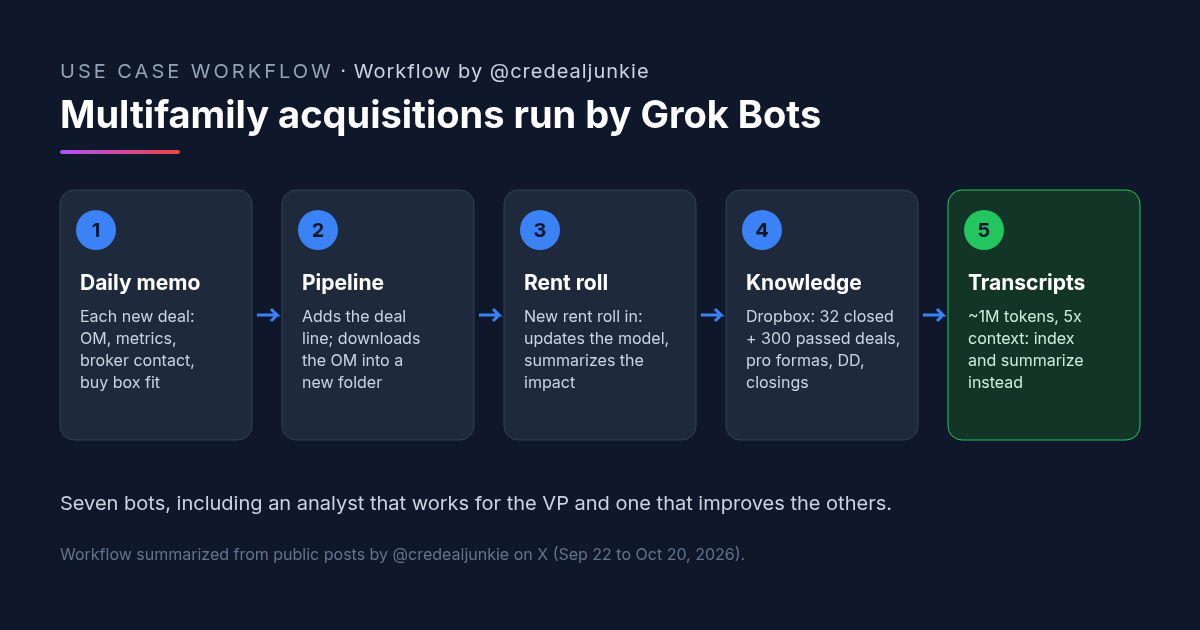
Multifamily Acquisitions With Grok Bot: A VP of Acquisitions Bot and a Deal Knowledge Base
For multifamily acquisitions, Andrew Jeffery runs a Grok Bot VP of Acquisitions for deal memos and pipeline admin, plus a knowledge base of 300+ past deals.
Credit: @credealjunkie · Oct 23, 2026 · 6 min read
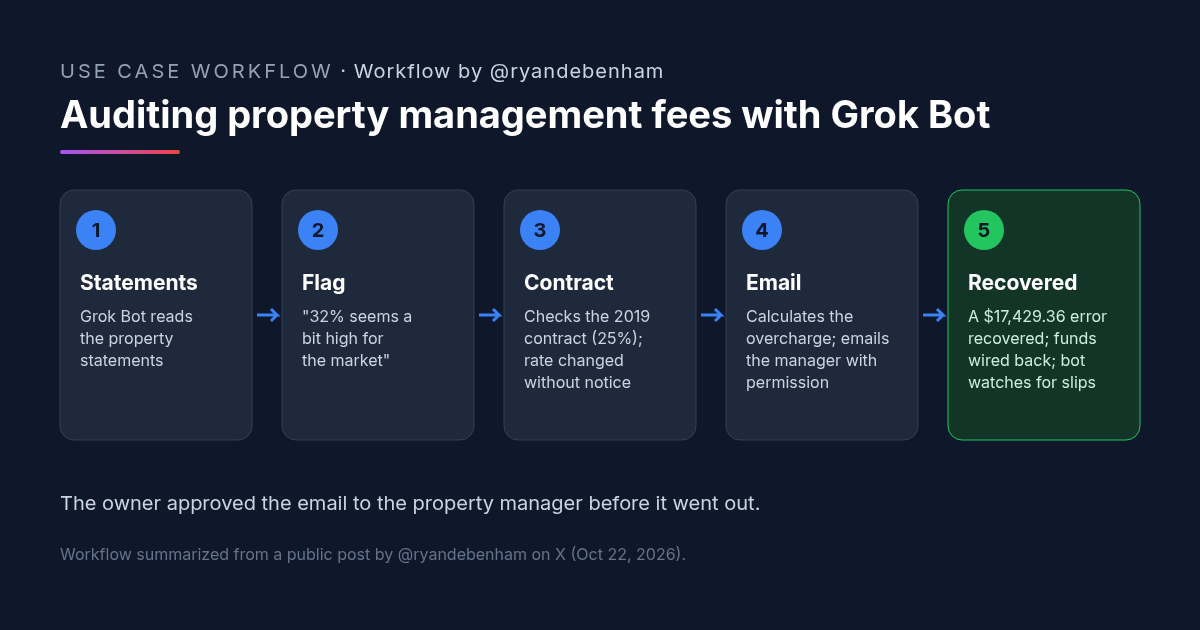
Property Management Fees Audit: How One Owner's Grok Bot Recovered a $17,429.36 Error
To audit property management fees, compare the rate on your statements to the signed contract. One owner's Grok Bot did it and recovered a $17,429.36 error.
Credit: @ryandebenham · Oct 23, 2026 · 4 min read
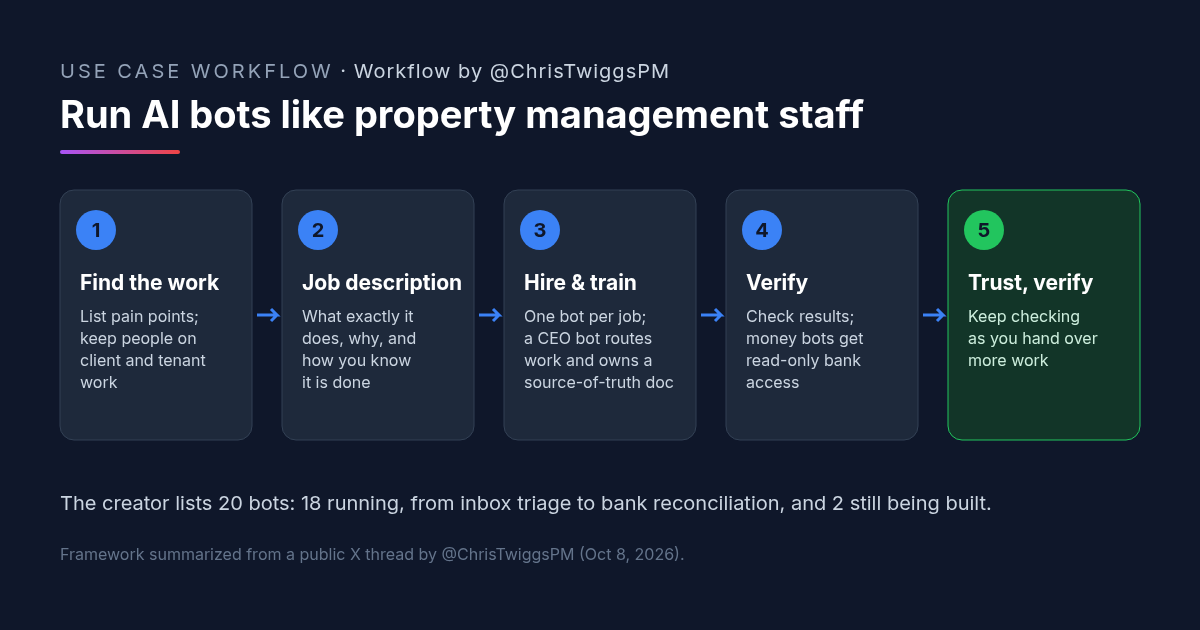
AI for Property Management: How One Property Manager Runs Grok Bots Like Staff
AI for property management: one broker runs 18 Grok Bots (2 more building) like staff. Hiring framework, job-description prompt, and checks.
Credit: @ChrisTwiggsPM · Oct 19, 2026 · 10 min read