Use case credit
Andrew Jeffery @credealjunkie
Andrew Jeffery (@credealjunkie) shared how they built a deal knowledge base with Grok Bot for their multifamily platform, in a post on X on Oct 16, 2026, and described their VP of Acquisitions bot in earlier posts.
The Multifamily Acquisitions Bot Team: Seven Grok Bots
Andrew Jeffery works on what they call "our SF multifamily platform." Asked on X what each of their Grok Bots does, Jeffery listed seven:
- "Nightly news search and summary"
- "My VP of acquisitions"
- "My acquisitions analyst (works for VP)"
- "A Task Rabbit (random stuff)"
- "Knowledge Base - building a knowledge base"
- "RSL bot - reviews and improves the other bots"
- "Grok Bot - mostly useless bot they added for me, checks random things and sometimes has good ideas"
Across several posts from September and October, Jeffery shows what the acquisitions bots and the knowledge base actually do.
A Daily Multifamily Acquisitions Memo Instead of Listing Alerts
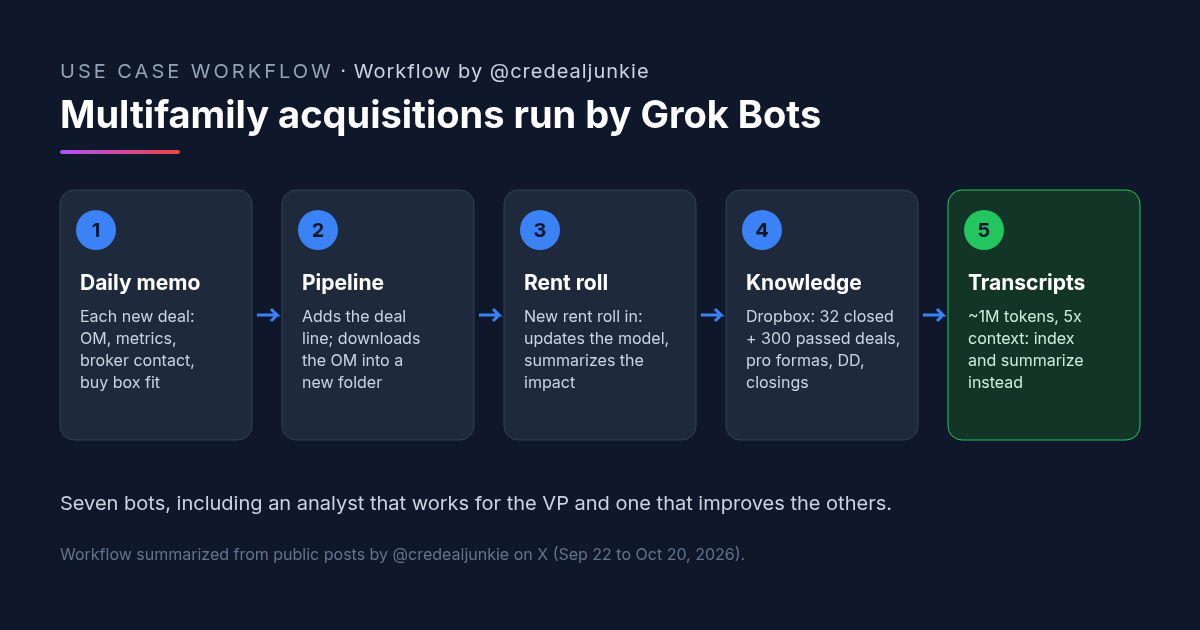
Jeffery's Sep 22 post compares two daily emails. LoopNet: "Here's a listing you already saw and probably passed on." The Grok Bot VP of Acquisitions: "Here's a memo on each deal that's come in over the last 24 hours, including OMs, metrics, broker contact, and buy box fit."
For a buy-box screening setup built from scratch, see our article on off-market deal sourcing with AI.
Multifamily Acquisitions Admin: Pipeline Lines and Deal Folders
In an Oct 11 reply, Jeffery gives the command: "Add (123 Main Street) to my pipeline and add a folder." Grok Bot "goes into my pipeline file and adds a line for the new deal, with pertinent deal data. Then goes into my email, finds the OM / deal room, downloads everything, creates a new folder for the deal and drops in the docs."
Jeffery calls it a "small time savings but the first step and removes more garbage admin work from my plate." The next step would be a first model pass, "which I already do in Claude - tbd if I teach grokbot the PF skill or leave that separate."
When a Rent Roll Changes, Multifamily Acquisitions Models Update
In an Oct 14 post, the bot started the work. "Hey, the broker sent a new rent roll for [123 mail street]. Do you want me to update the latest model and summarize the impact?" Jeffery said yes, and two minutes later: "Done, here's a copy - the IRR went up 300bps."
A 300bps move from one new rent roll is the kind of result to open and check, line by line, before it goes into an investment memo.
Building a Multifamily Acquisitions Knowledge Base From Past Deals
The Oct 16 post describes the biggest project. Jeffery "blew through 50% of my weekly GrokBot usage this morning" doing this:
- "Iterated on a prompt to create a Knowledge Base for our SF multifamily platform"
- "GrokBot built the structure inside Dropbox"
- "Pulled in pro formas, closing statements and DD findings for all closed deals in the past 24 months (32 and counting), plus the 300 we underwrote but passed on."
- "Added transcripts of 3 months of meetings - not comprehensive but a start"
Jeffery admits the use isn't fully defined yet: "Do I know exactly how we'll use this new knowledge base or what else we'll add? Not exactly." The plan for that: "once it gets built I just ask the bots who built it how to use it."
Why Multifamily Acquisitions Transcripts Need Indexing
Jeffery's view is that these tools are "very good at ripping through spreadsheets and pulling out numbers," and that connectors make it "trivial to query across platforms (DropBox, email, Gemini, Granola, Slack, etc)." But "they struggle with words."
The numbers: "Transcripts from about 30 meetings were around 1 million tokens, 5x what GrokBot said it could hold in context." So the transcripts "have to be ingested, indexed, summarized, etc - which is an imperfect process but more accurate than a LLM that drifts when its context is overloaded."
How to Try It: A Multifamily Acquisitions Knowledge Base Prompt
Jeffery iterated on a prompt but didn't publish it. The one below is a CRE AI Studio add-on based on the structure in their post. Start with a handful of deals and check the results before loading all of them.
[CRE AI Studio prompt, written for this article]
Build a knowledge base for our multifamily acquisitions in [DROPBOX FOLDER]. Don't delete or move any original files; copy them.
Structure:
- /Closed deals/<property name>/ with the pro forma, closing statement and due diligence findings
- /Passed deals/<property name>/ with the pro forma we underwrote and, if we have it, why we passed
- /Meetings/ with transcripts
For each deal, create a one-page summary: address, unit count, price, key underwriting assumptions, outcome (closed or passed) and the source file for every number.
For meeting transcripts, don't try to hold them all at once. Summarize each meeting separately with its date, the deals discussed and the decisions made, and build an index by deal and by date.
Then tell me what's missing, which files you couldn't read, and how I should query this knowledge base.What to Check in a Multifamily Acquisitions Bot Setup
- Model changes. When a bot updates a model, compare the changed inputs and outputs to the prior version before you use the result.
- Memo sources. Every metric in a deal memo should trace to the OM or the broker's files.
- Summaries of transcripts. Indexing is, in Jeffery's word, imperfect. Spot-check summaries against the original transcript.
- Folder permissions. A knowledge base holding closing statements and meeting notes needs the same access controls as the originals.
- Usage limits. One morning of building used half of Jeffery's weekly Grok Bot usage. Plan large loads around that.
FAQ: Multifamily Acquisitions With Grok Bot
What does a Grok Bot VP of Acquisitions do in multifamily acquisitions?
What goes into a multifamily acquisitions knowledge base?
Why index meeting transcripts for multifamily acquisitions instead of loading them all?
Can Grok Bot update a multifamily acquisitions model on its own?
More AI use cases
All use cases →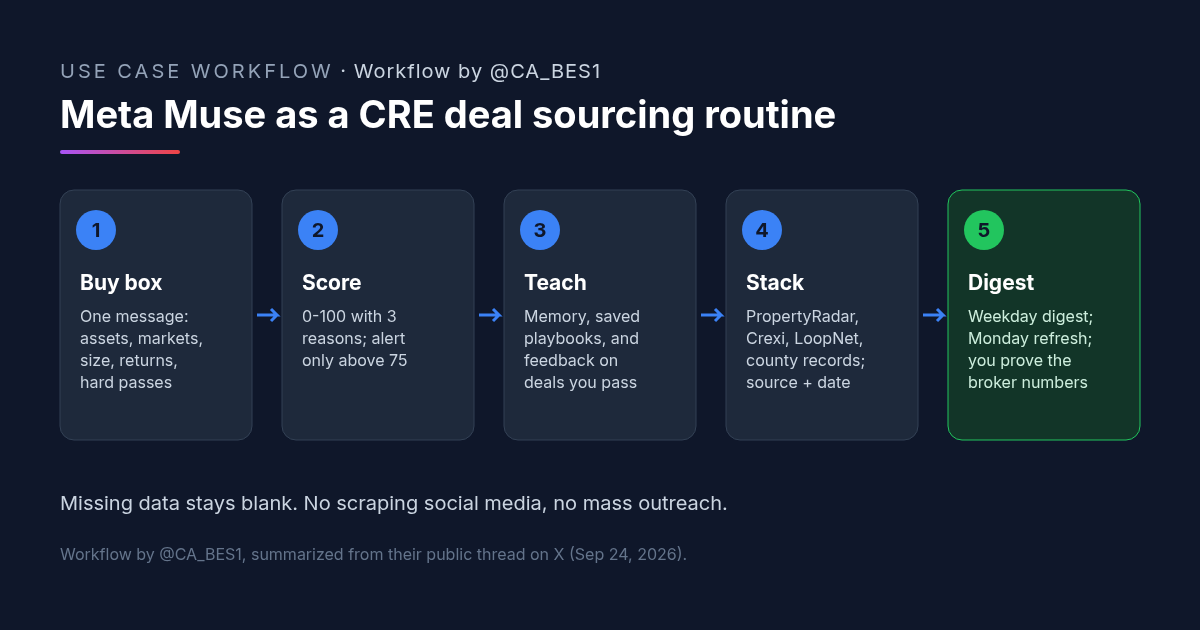
Meta Muse for CRE Deal Sourcing: A Buy Box, Lead Scores and a Daily Digest
Meta Muse can run CRE deal sourcing: give it your buy box, have it score leads 0-100 with reasons, rerun saved searches weekly and alert only above 75.
Credit: @CA_BES1 · Oct 23, 2026 · 6 min read
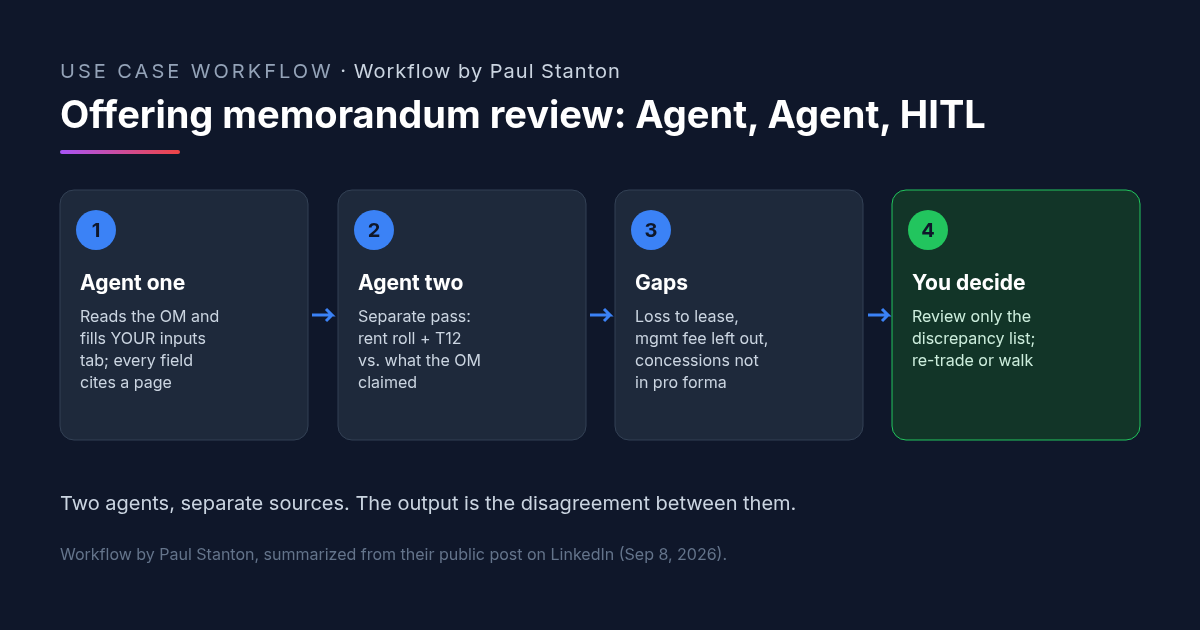
Offering Memorandum Review With Two Claude Agents and a Human Check
Review an offering memorandum with two Claude agents: one maps the OM to your inputs tab with page cites, one audits it against the rent roll and T12.
Credit: in/pauljstanton · Oct 23, 2026 · 6 min read
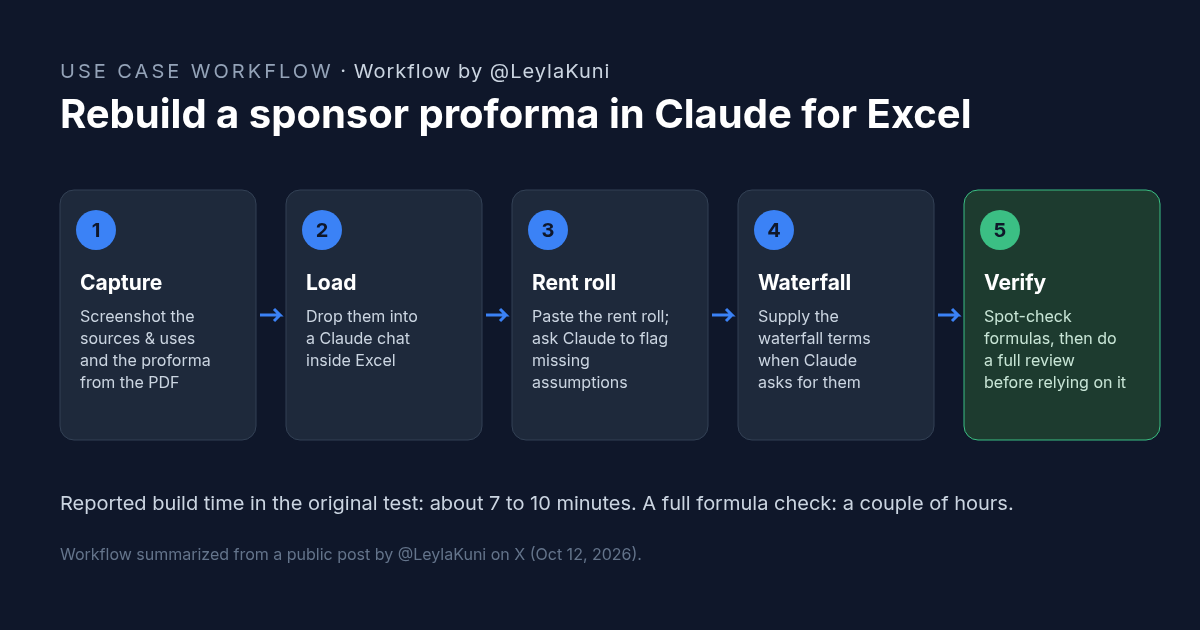
How to Rebuild a Real Estate Proforma in Claude for Excel
Rebuild a sponsor proforma in Claude for Excel from screenshots and a rent roll in about 10 minutes. Workflow, copyable prompt, and what to check.
Credit: @LeylaKuni · Oct 19, 2026 · 6 min read