Use case credit
Jason Brenizer @jbrenizer
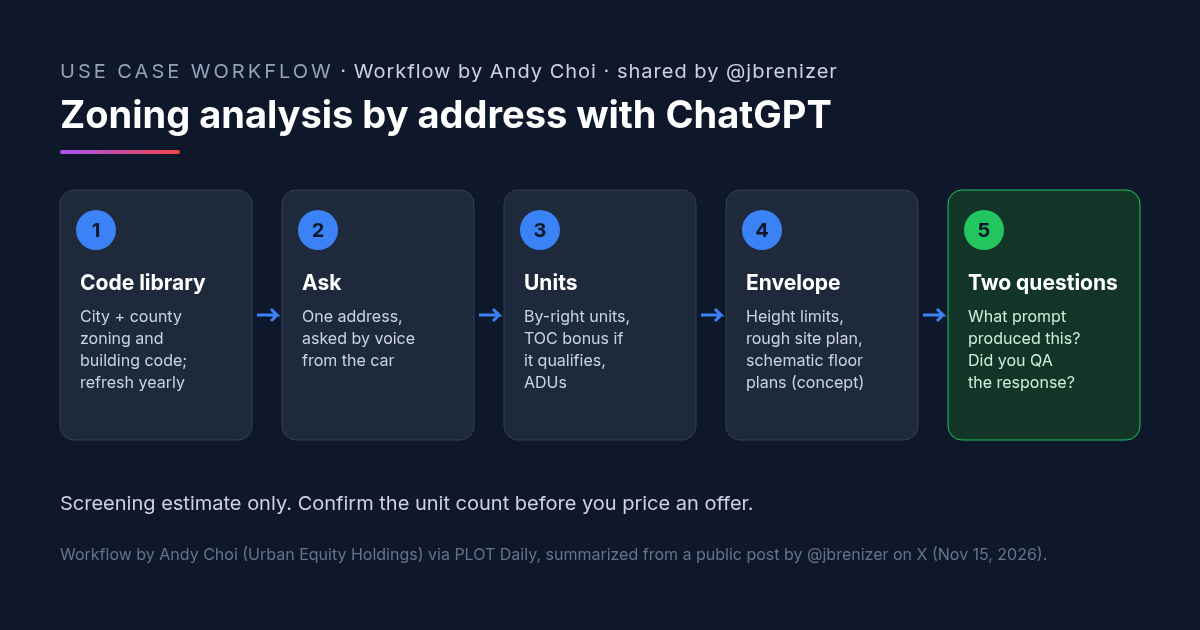
Jason Brenizer (@jbrenizer) shared this zoning workflow in a post on X on Nov 15, 2026. The workflow is Andy Choi's, at Urban Equity Holdings, as reported by PLOT Daily for the AI for CRE Collective.
What Andy Choi Did: Zoning Analysis by Address Instead of a Two-Week Report
Andy Choi runs Urban Equity Holdings, a Los Angeles real estate private equity firm focused on urban infill multifamily and mixed use. Jason Brenizer's post opens with the problem: "an architect's feasibility report on an infill lot used to take Andy Choi one to two weeks." The story comes from a PLOT Daily case study for the AI for CRE Collective, based on Choi's interview on the collective's podcast.
The question that report answered is the one that decides an infill deal: how many units fit on the lot. Choi's team first stopped paying for feasibility reports and ran the calculation themselves in a custom Excel sheet. That worked, PLOT Daily writes, but added "a new failure mode: manual data entry, one wrong cell." So they moved the code into the model.
Zoning Analysis Step 1: Load the City and County Code Into ChatGPT
The team "uploaded thousands of PDFs of Los Angeles City and County zoning code and building code into ChatGPT," and refreshes that library "in the first quarter of each year as new California code editions come out." The model answers from the code the team gave it, not from whatever it remembers.
Zoning Analysis Step 2: Ask by Address, by Voice
"The question is now just an address, asked by voice." Choi asks from the car. "By the time I get to the property, I already know how many units we could build."
Zoning Analysis Step 3: By-Right Units, Bonus Density and ADUs
The answer covers what is buildable by right, what the Transit Oriented Communities (TOC) bonus density adds if the site qualifies, and whether ADUs are available. TOC is a Los Angeles program, so the bonus you ask about depends on your city's code.
Zoning Analysis Step 4: A Rough Envelope From the Image Model
An image model handles the next step in the same pass: a rough envelope with height restrictions, a rough site plan and rough schematic floor plans. PLOT Daily notes that what used to be two trips to the architect, unit count first and massing second, is now one prompt.
Zoning Analysis Step 5: Two Questions Before Anything Leaves the Firm
Every AI-assisted deliverable at the firm has to answer two questions: "What prompt did you use to generate this. And did you QA the response." PLOT Daily calls those two questions "the whole control system" when applied to rent comps and underwriting.
Why a Code Library Makes AI Zoning Analysis Worth Checking
The stakes are specific. Choi says being off by one unit is roughly $30,000 of NOI, "and that can make a big difference in the equity multiple and the returns."
His case for trusting the output is that zoning code is deterministic: "The zoning code at the end of the day is all ones and zeros, you know, it's mathematical equations." He says the unit counts have been accurate across "hundreds of case studies." PLOT Daily reports that as his claim and says it did not audit it.
The same article names the problem with relying on any single answer. The same prompt returns different answers in ChatGPT and in Claude, and a fresh window in the same model returns something roughly 10% different again. That is why the useful part of this workflow is the library of current code plus the two review questions, not the model's first answer. Brenizer's post puts it plainly: treat the answer "as a screening estimate, not a zoning determination."
Choi is also clear about where the tools fall short. He generates renderings and floor plans and does not trust them; in his view the design tools are good for concept, not for final schematics or construction documents.
How to Try It: A Zoning Analysis Prompt for Your Own Code Library
Start with the one city where you buy most often. Download the current zoning code and building code, note the edition year on each file, and put them in a ChatGPT project (or another tool that answers from uploaded files). Neither the post nor the PLOT Daily article publishes Choi's prompt. The prompt below is CRE AI Studio's, written from the steps in the article.
[CRE AI Studio prompt, written for this article from the steps PLOT Daily describes]
Use only the zoning code and building code files in this project for [city / county], editions [years]. If the files don't answer something, say so. Do not fill gaps from memory.
Site: [address], parcel [APN], lot size [square feet], current zone [zone, if known].
1. Quote the zone and any overlay that applies, with the code section for each.
2. Give the by-right limits that control unit count (density, height, floor area, setbacks, parking), each with its code section.
3. Work out the maximum by-right unit count and show the arithmetic step by step.
4. Check whether a density bonus program in these files could apply (for Los Angeles, Transit Oriented Communities). List the facts I must confirm to qualify, and the unit count if it does.
5. Say whether ADUs are allowed on this lot and how many.
6. End with every assumption you made and every fact I need to confirm with the planning department or an architect.Run the same address in a fresh chat and, if you can, in a second model. If the unit counts differ, find the code section that explains why before you use either one.
What to Check in an AI Zoning Analysis Before You Price an Offer
- Code editions. Confirm the files are the current editions and include recent amendments and overlays. Choi's team refreshes its library every year.
- Section citations. Every limit in the answer should point to a section you can open. A rule with no section is a guess.
- The arithmetic. Rework the unit count yourself from lot size, density and any rounding rule. One unit was about $30,000 of NOI in Choi's numbers.
- Bonus eligibility. Programs like TOC have conditions such as distance to transit and affordable unit set-asides. Confirm each condition for the parcel.
- Model variance. Run it twice. If two runs disagree, the answer isn't ready.
- Renderings and floor plans. Use them for concept only. Choi doesn't rely on them for schematics.
- The two questions. Before the analysis goes to a partner or into an offer: what prompt produced it, and who checked it.
- Final confirmation. Confirm the unit count with an architect or the planning department before you price an offer.
FAQ: Zoning Analysis With ChatGPT
What is a zoning analysis?
Can ChatGPT do a zoning analysis by address?
How accurate is an AI zoning analysis?
Does an AI zoning analysis replace an architect's feasibility study?
More AI use cases
All use cases →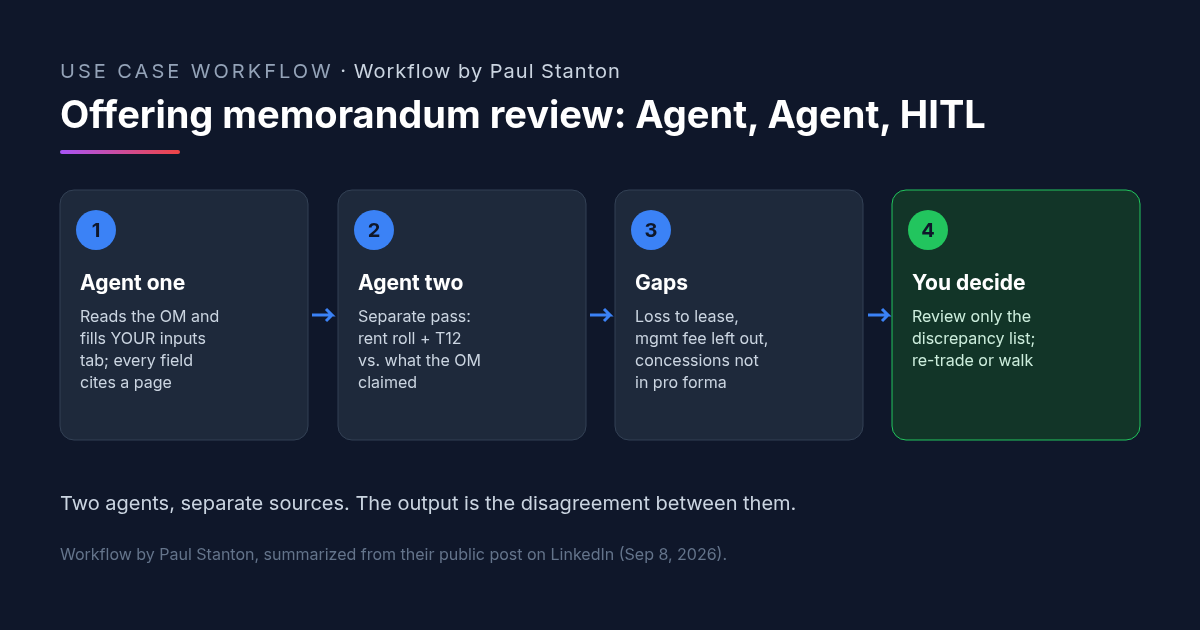
Offering Memorandum Review With Two Claude Agents and a Human Check
Review an offering memorandum with two Claude agents: one maps the OM to your inputs tab with page cites, one audits it against the rent roll and T12.
Credit: in/pauljstanton · Oct 23, 2026 · 8 min read
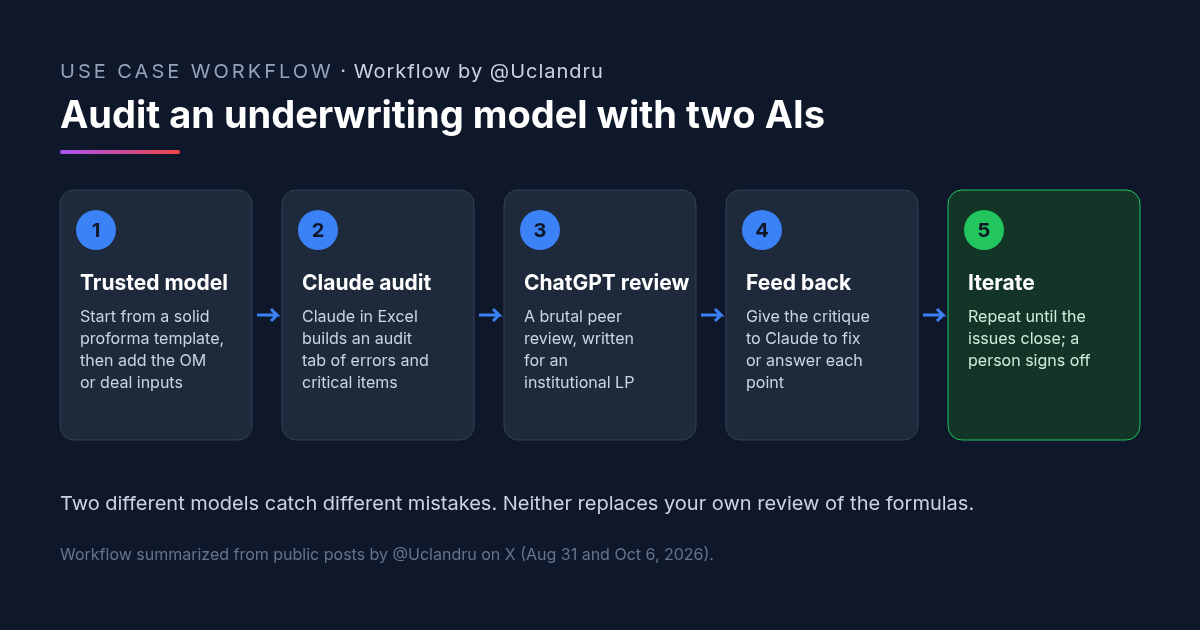
How to Review a Real Estate Underwriting Model With Claude and ChatGPT
Real estate underwriting review: Claude builds an audit tab, ChatGPT peer-reviews like an institutional associate, then back to Claude. Prompts and checks.
Credit: @Uclandru · Oct 19, 2026 · 11 min read
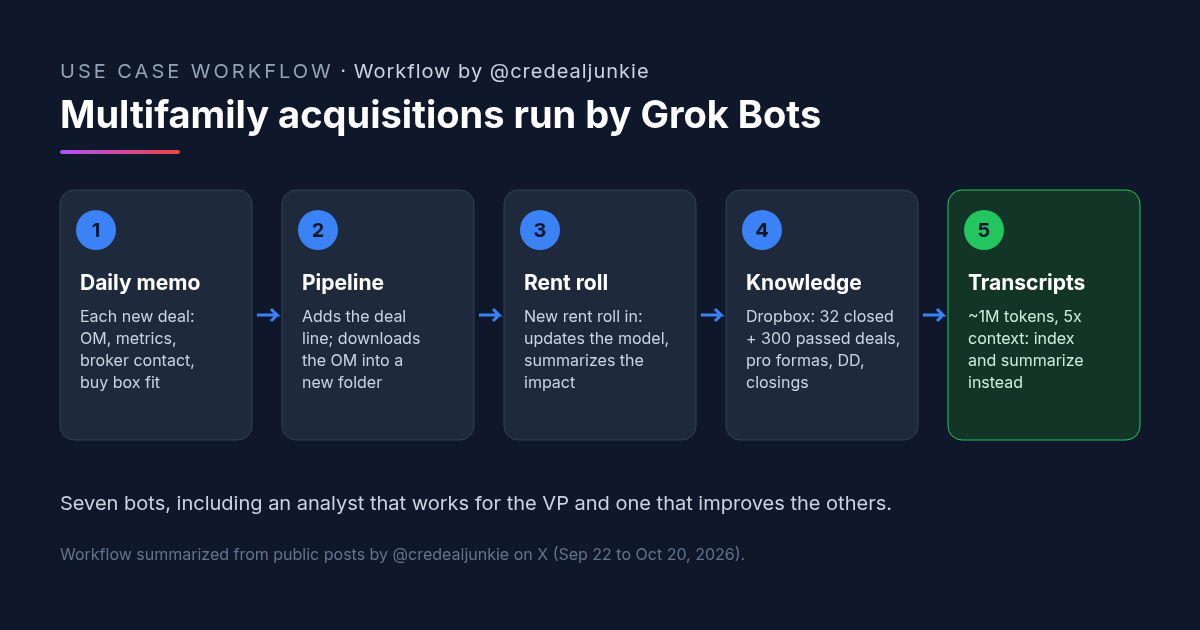
Multifamily Acquisitions With Grok Bot: A VP of Acquisitions Bot and a Deal Knowledge Base
For multifamily acquisitions, Andrew Jeffery runs a Grok Bot VP of Acquisitions for deal memos and pipeline admin, plus a knowledge base of 300+ past deals.
Credit: @credealjunkie · Oct 23, 2026 · 6 min read