Use case credit
Paul Stanton in/pauljstanton
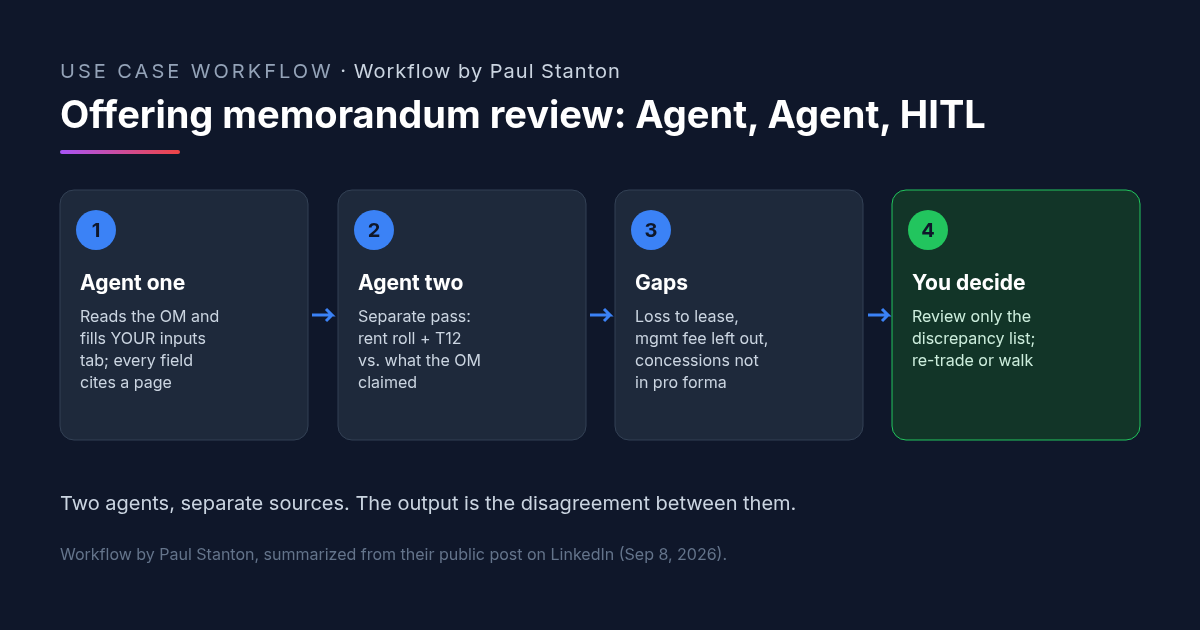
Paul Stanton (in/pauljstanton) of Thesis Driven laid out this Agent, Agent, HITL workflow for abstracting and auditing OMs in a post on LinkedIn on Sep 8, 2026.
What Stanton Proposes: Offering Memorandum Review as Three Jobs, Not One
Paul Stanton of Thesis Driven calls it "Agent, Agent, HITL," and says it is "the new workflow for abstracting and auditing OMs. Every real estate GP should be using it."
Their starting point is a common mistake: "Most GPs working with Claude to underwrite deals are building one agent, dropping in an OM and asking it to 'underwrite the deal'. That's the wrong workflow. Reading an OM isn't one job, it's three."
The Offering Memorandum Workflow: Agent, Agent, HITL
Offering Memorandum Agent One: Fill Your Own Inputs Tab
"Give it your own model's inputs tab as the schema. Not a generic template but the one your firm already uses."
The first agent "isn't deciding anything. It maps the broker's assumptions onto fields you already defined. Rent growth, loss to lease, expense ratio, exit cap, T12 versus pro forma... etc." And: "Have every field cite the page it came from."
Offering Memorandum Agent Two: Audit the Rent Roll and T12 Against the OM
A "separate agent with a separate pass. Feed it the rent roll and the T12. It has one job: compare actual to asserted, and flag every gap."
The kinds of gaps Stanton says it catches:
- "Broker says 3 percent loss to lease and rent roll says 8"
- "The expense ratio excludes the management fee"
- "Rent concessions never made the pro forma"
Offering Memorandum Step Three: The Human in the Loop
"Human-In-The-Loop. That's you. You get a list of discrepancies instead of a 90 page PDF." The decisions stay with you: "Decide if it's a sloppy broker, or a deal that doesn't pencil? Re-trade or walk?"
"Build this once and it runs on every deal."
Why Two Agents Catch More in an Offering Memorandum
"Splitting the agents is the trick," Stanton writes. "Because one agent doing both will reconcile its own errors and hand you something clean. You need two agents with separate sources, so the output you get is the disagreement between the two."
- Separate sources. Agent one only sees the OM. Agent two works from the rent roll and T12. A gap shows up because the two inputs disagree, not because one model noticed its own mistake.
- Your schema, not the broker's. Mapping the OM onto the inputs tab your firm already uses puts the broker's numbers in the same fields as every other deal you've underwritten.
- Page citations. Every field points back to a page, so you can check a number in seconds instead of rereading the OM.
- Short review. You read a discrepancy list, not the whole document.
The same idea, a separate checker working from separate inputs, is behind two of our other articles: real estate underwriting model review with Claude and ChatGPT and checking AI spreadsheet analysis.
How to Try It: Two Offering Memorandum Agent Prompts
Stanton's post doesn't include their prompts or skill file. It promotes a Thesis Driven session where Oscar, the firm's GM, walks through "the full build," with the model, project files and a skill file. The two prompts below are ours, written from the jobs Stanton describes. Run them in two separate chats or projects so the second agent never sees the first agent's output.
[CRE AI Studio prompt, Agent One: offering memorandum to inputs tab]
I'm attaching an offering memorandum and our model's inputs tab. The inputs tab is the schema. Fill each field with the broker's stated assumption from the OM.
Rules:
- You are not underwriting or judging the deal. Only map what the OM states onto our fields.
- For every field, give the value, the exact wording from the OM, and the page number.
- If the OM doesn't state a value for a field, leave it blank and write "not stated". Do not estimate.
- Where the OM gives both a T12 figure and a pro forma figure, record both and label them.
Return a table: field, value, OM wording, page.[CRE AI Studio prompt, Agent Two: rent roll and T12 audit]
I'm attaching a rent roll, a T12, and a list of the claims made in an offering memorandum (loss to lease, occupancy, in-place rents, expense ratio, concessions, management fee and any other stated figures).
Your one job: compare what the rent roll and T12 actually show with what the OM asserted, and flag every gap.
- For each claim, give the OM figure, the figure from the rent roll or T12, the difference, and where you found it (row or line item).
- Check specifically whether the expense ratio includes a management fee and whether any concessions are missing from the pro forma.
- Calculate from the line items. Do not trust stated totals.
- If something can't be checked from these files, say so instead of guessing.
Return only the list of discrepancies, largest first.For agent two, paste the OM's claims as a short list rather than the whole OM, so it audits against the documents instead of rereading the broker's story.
What to Check Before Acting on an Offering Memorandum Review
- Spot-check citations. Open a sample of agent one's page references and confirm the value is on that page.
- Blank means blank. Fields the OM doesn't state should come back empty, not filled with a typical number.
- Recalculate the gaps. Before you re-trade, recompute the biggest discrepancies yourself from the rent roll and T12.
- Keep agents apart. If both agents share a chat or project, the second can see the first one's answers, which defeats the point.
- The decision is yours. The discrepancy list tells you what to ask. Whether the deal still pencils is your call.
FAQ: Offering Memorandum Review With Claude
Can Claude review an offering memorandum?
Why use two agents for an offering memorandum instead of one?
What does the offering memorandum audit agent look for?
What schema should the offering memorandum agent fill?
More AI use cases
All use cases →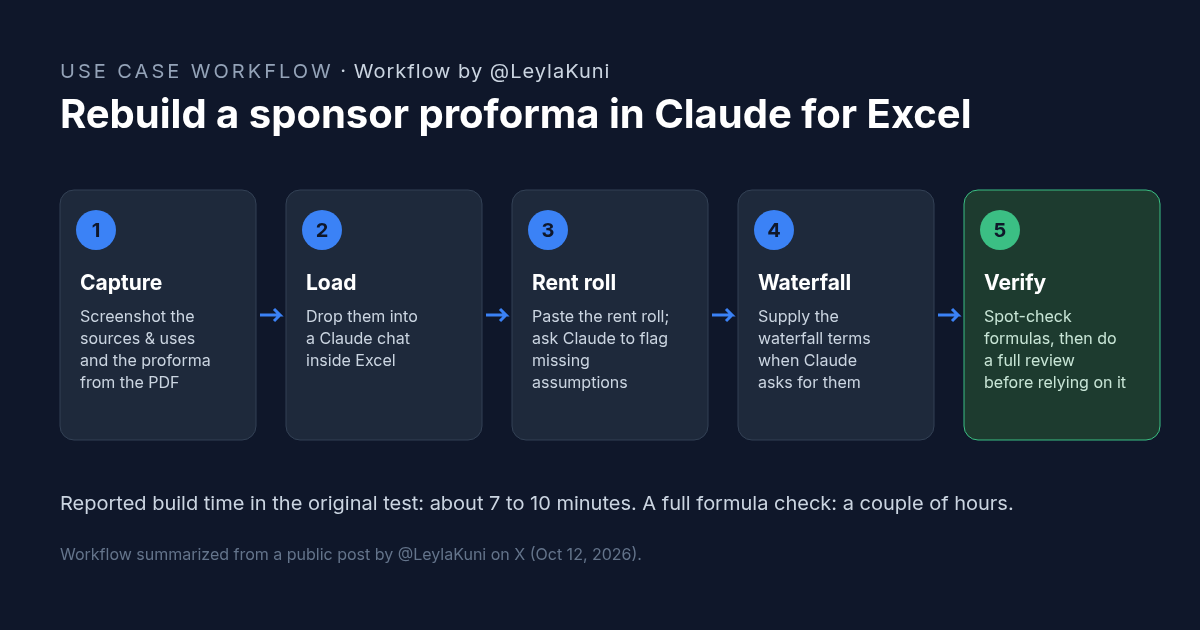
How to Rebuild a Real Estate Proforma in Claude for Excel
Rebuild a sponsor proforma in Claude for Excel from screenshots and a rent roll in about 10 minutes. Workflow, copyable prompt, and what to check.
Credit: @LeylaKuni · Oct 19, 2026 · 6 min read
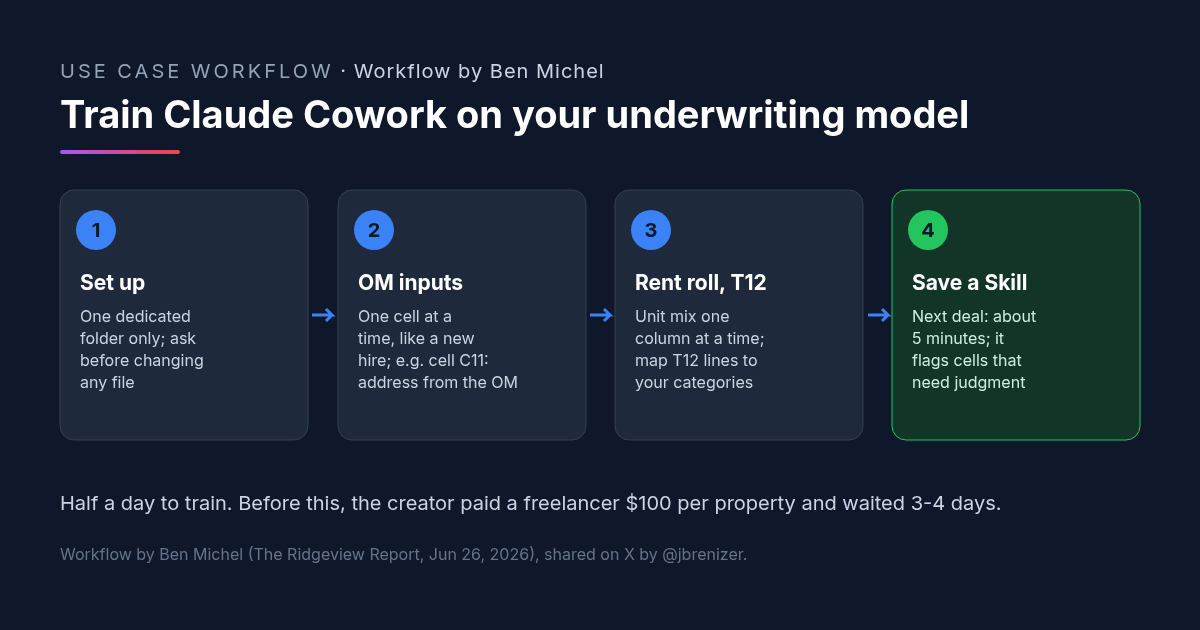
Multifamily Underwriting With Claude Cowork: How One Investor Trained It on His Own Spreadsheet
Multifamily underwriting with Claude Cowork: one investor taught it his model from the OM, rent roll and T12, saved a Skill, and now fills it in 5 minutes.
Credit: @jbrenizer · Oct 19, 2026 · 6 min read
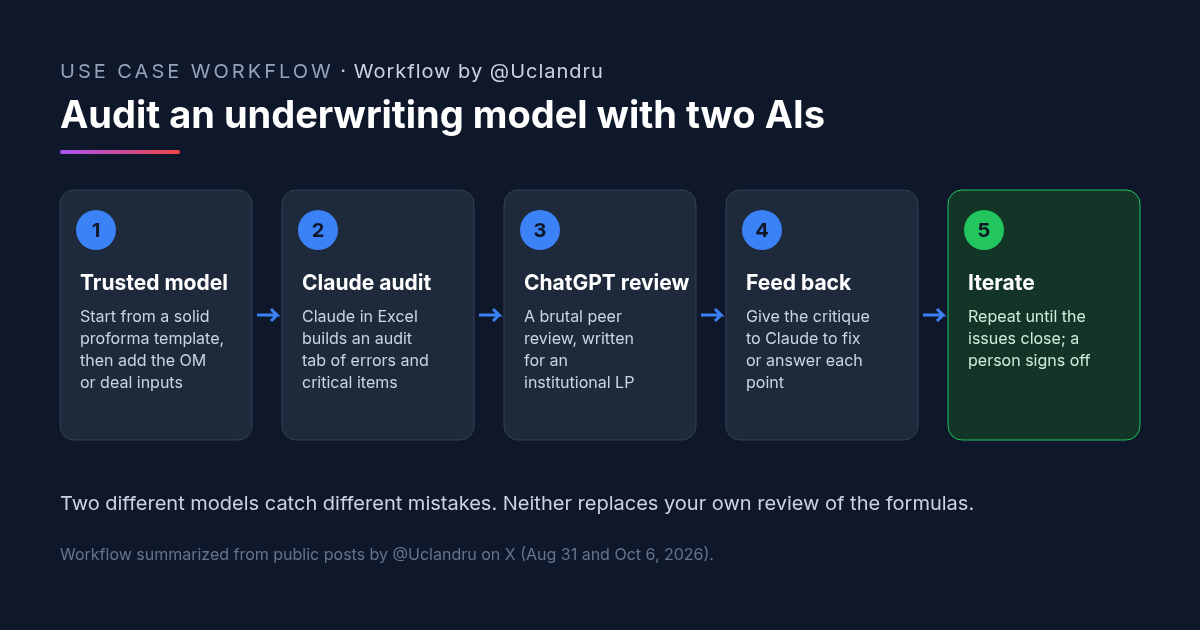
How to Review a Real Estate Underwriting Model With Claude and ChatGPT
Real estate underwriting review: Claude builds an audit tab, ChatGPT peer-reviews like an institutional associate, then back to Claude. Prompts and checks.
Credit: @Uclandru · Oct 19, 2026 · 6 min read